Recently, the Carbon-based Resource Electrocatalysis Conversion Research Team of the State Key Laboratory of Catalysis Conversion at the Dalian Institute of Chemical Physics (DICP), Chinese Academy of Sciences, in collaboration with Prof. Qingda An’s team from Dalian Polytechnic University, has achieved new progress in regulating the high-temperature oxygen evolution reaction (OER) performance of solid oxide electrolysis cell (SOEC) anodes. The research significantly enhanced the high-temperature OER activity and stability by modulating the surface electronic structure of the anode material.
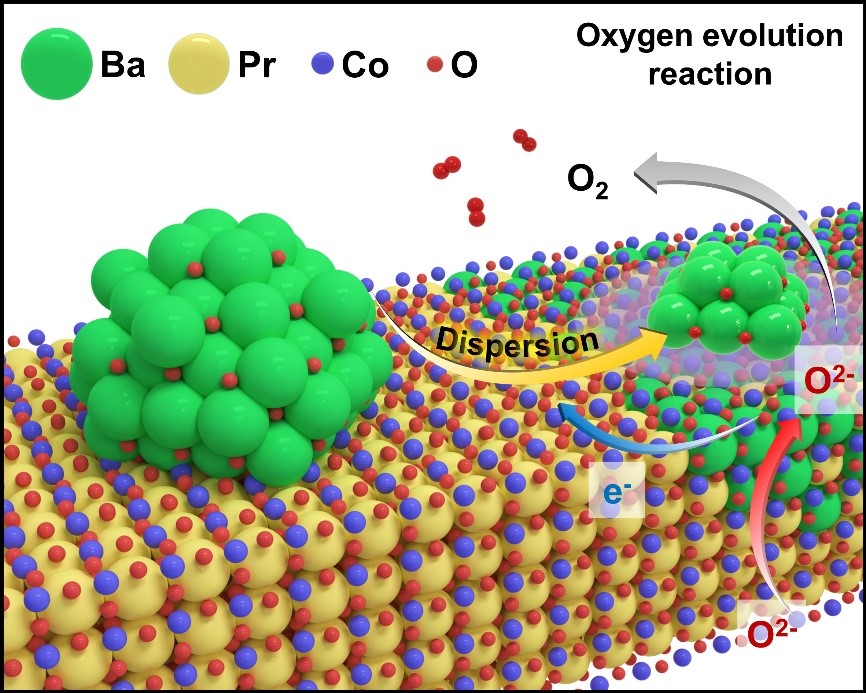
High-temperature CO2 electrolysis in SOEC is a promising carbon utilization technology, attracting widespread attention in the energy and environmental fields due to its advantages of low overpotential, high current density, and high energy efficiency. Among the processes, OER is a key rate-limiting step occurring primarily at the electrode surface. Therefore, optimizing the anode surface electronic structure to enhance lattice oxygen activity and charge transport capability is a crucial strategy for improving the overall performance of SOEC.
This study introduced Ba onto the surface of a Pr0.9CoO3−δ anode via a high-temperature self-dispersion method, creating an active surface/interface structure of PrBaCo2O5+δ-Pr0.9CoO3−δ loaded with BaO nanoparticles. The research revealed that the introduction of Ba shifts the O 2p band center towards the Fermi level and increases the valence state of Co, thereby reducing the minimum electron transition energy barrier. This accelerates the charge transfer process at the anode surface, lowers the polarization resistance associated with electron transport and surface/interface reactions, and enhances ionic and electronic conduction. Additionally, the surface BaO nanoparticles promote the interfacial oxygen spillover process, further boosting OER performance. This work provides a new strategy for designing high-performance SOEC anode materials, and offers theoretical and experimental support for developing efficient solid oxide electrochemical devices.
The related findings were published in the Journal of the American Chemical Society under the title “Optimizing Surface Electronic Structure by Ba Dispersion for Enhanced High-Temperature Oxygen Evolution Reaction Activity”. The co-first authors of this work are Hewei Liu (a joint graduate student from Dalian Polytechnic University and DICP) and Mengna Wang (a graduate student jointly supervised by Dalian Jiaotong University and DICP). This work received financial support from the National Key R&D Program of China, the National Natural Science Foundation of China, and other projects. (Text/Images: Hewei Liu, Yuefeng Song)
Article Link: https://doi.org/10.1021/jacs.5c03987