The concept of interface confinement proposed and developed by Prof. BAO Xinhe and Prof. FU Qiang's team through studies on oxide/metal model catalyst system, has become an important framework for understanding the formation and stabilization of low-dimensional oxide active structures. In recent years, the team further extended this concept to oxide/oxide systems. However, compared with oxide-metal interfaces, the physical origin and general principles of interface confinement at oxide-oxide interfaces remain less well understood.
Recently, a research group led by Prof. Bao. Xinhe and Prof. FU Qiang from the Dalian Institute of Chemical Physics (DICP) of the Chinese Academy of Sciences (CAS) was invited to publish a review article on interface-confined catalysis at oxide-oxide interfaces.
The review article was published in Accounts of Materials Research.
In this review, the authors systematically summarized the construction strategies, structural characteristics, and theoretical framework of interface-confined metal oxide nanolayers. They pointed out that the confinement effect at oxide-metal interfaces mainly originates from interfacial metal-metal bonding, whereas that at oxide-oxide interfaces mainly arises from interfacial metal-oxygen-metal bonding. The authors further emphasized future directions, including dynamic confinement catalysis, inverse interface effects, and structural/electronic descriptors.
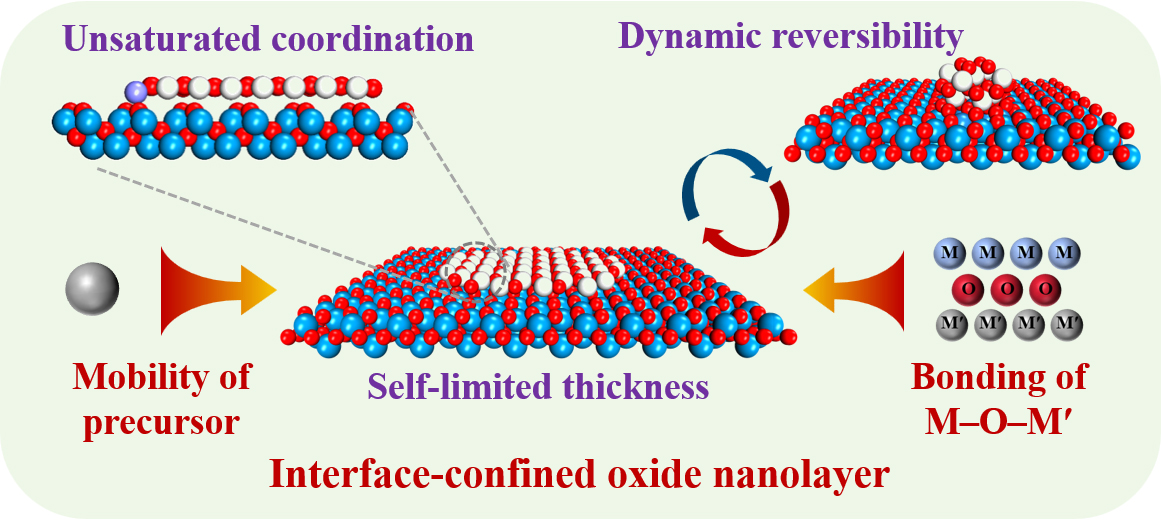
Schematic illustration of interface-confined oxide nanolayers (Image by LI Rongtan)
"This review highlights the pushing-pulling effect in interface confinement, where external stimuli push the structure away from interface-confined metastable state, while the interface confinement effect acts as a restorative force that pulls it back, opening new opportunities for dynamic confinement catalysis," said Prof. FU.
Article Link: https://pubs.acs.org/doi/full/10.1021/accountsmr.6c00009